

From driving innovation to enabling digital transformation at scale, India is now the engine for global enterprise capability. However, for tech-first GCCs to provide sustained value, simply relying on talent or a good ecosystem is not enough. To be successful, companies need strategic consulting partnerships to carry out their vision. This paper outlines why those partnerships are critically important, the partnership models available, and how organizations can develop a GCC model that incorporates their company’s ongoing strategic vision as part of the execution strategy.
The Rise of Tech-First GCCs in India
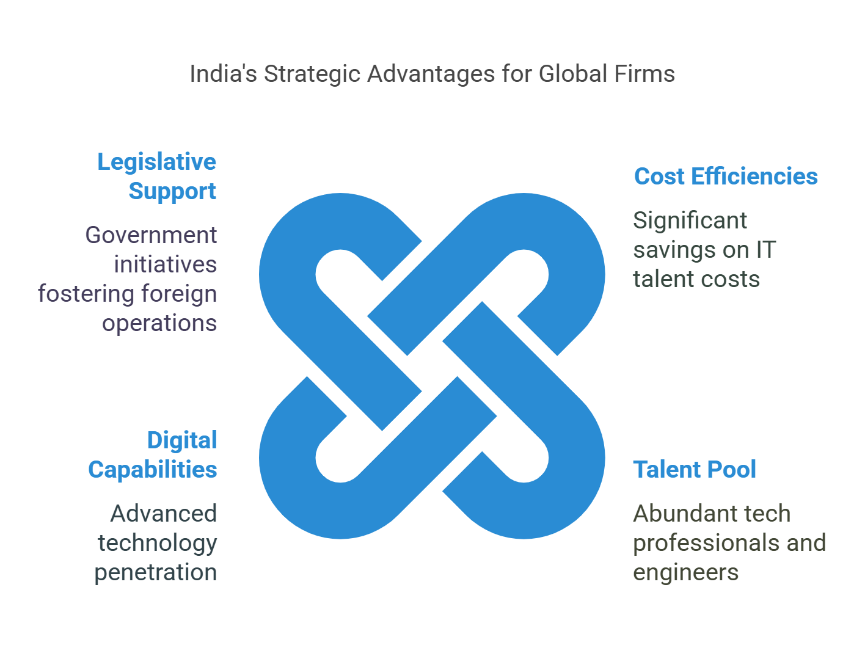
India’s path as a GCC hub is bolstered by a combination of positive factors:
- Cost efficiencies: While labour costs vary by business model, many firms benefit from up to 70% savings on IT talent costs compared with developed markets while still retaining the right level of service stack and quality.
- Talent pool: India has upwards of 5 million tech professionals and a continuous pipeline of engineers and data scientists equipped for advanced skills in areas such as AI, machine learning, and cybersecurity.
- Digital capabilities: Technologies like digital twins, blockchain, and cloud are widely adopted, making India a compelling innovation partner.
- Legislative support from Government: Initiatives such as “Make in India” and SEZ-based tax support have created a favourable environment for foreign firms to operate efficiently.
With more than 1,700 active GCCs and continued growth, the market is on a trajectory to reach USD 110 billion by 2030. However, a large-scale GCC does not guarantee success.
The Challenges Behind the Promise
Setting up a tech-first GCC in India presents its own set of complexities:
- Regulatory Navigation: Compliance with India’s evolving data protection laws, labour codes, and tax structures can be difficult for foreign companies.
- Talent Retention: High attrition rates in tech clusters like Bengaluru and Hyderabad demand effective employer branding and upskilling strategies.
- Operational Readiness: Integrating enterprise-grade digital platforms requires coordinated execution and maturity.
- Strategic Alignment: Without expert guidance, aligning the GCC with the parent company’s innovation and transformation roadmap often proves challenging.
This is where strategic consulting partnerships become critical.
Why Strategic Consulting Partnerships Matter
1. Accelerated Setup with Regulatory Expertise
Consulting firms offer deep familiarity with India’s legal and regulatory landscape. From location strategy to tax compliance and entity structuring, firms like KPMG India and Gloplax Solutions offer “GCC-as-a-Service” models that fast-track success.
2. Technology Integration & Innovation Hubs
Strategic partners enable tech-first GCCs to embed innovation from the start. Collaborators like Capgemini, Infosys, and HCLTech co-create AI labs, R&D centres, and Centers of Excellence that boost time-to-value and impact.
3. Talent Strategy and Workforce Enablement
By partnering with academic institutions and local firms, organizations can build robust hiring pipelines. This includes campus placements, training programs, and joint research with institutions like IITs.
4. Scalability with Flexible Operating Models
Consulting firms assist in selecting the right partnership framework:
| Model | Pros | Challenges |
|---|---|---|
| Build-Operate-Transfer (BOT) | Fast entry, phased control transfer | Initial dependency on partner |
| Joint Ventures | Shared innovation and risk | Complex governance |
| Managed Services | Core focus with flexibility | Limited execution control |
| Fully Owned Subsidiary + Support | Full control and customization | High setup complexity and cost |
Consultants help evaluate these models based on factors like scale, innovation requirements, and compliance complexity.
Case-in-Point: How Partnerships Deliver Value
- Walmart’s GCC in Bengaluru co-developed AI-powered supply chain optimization with local tech partners.
- Infosys and HCLTech assist global clients in building and transforming GCCs through tech enablement and recruitment.
- Capgemini supports value creation for both new and mature GCCs in automation, product design, and logistics.
Traditional IT vendors are becoming co-creators in the GCC ecosystem rather than competitors.
The GCC 2.0 Era
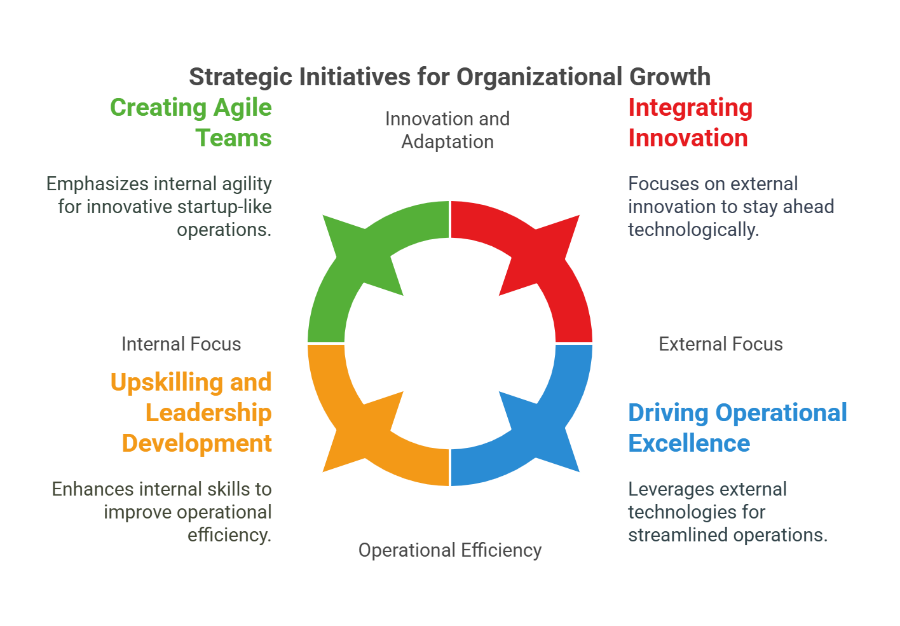
Modern GCCs are strategic, digital, and innovation-driven. To sustain this transformation, companies must:
- Integrate Innovation: Establish local R&D and co-innovation centres.
- Create Agile Teams: Build remote-first, outcome-driven squads that function like startups.
- Invest in Upskilling: Nurture digital, leadership, and cross-functional capabilities.
- Drive Operational Excellence: Leverage AI, automation, and real-time analytics.
- Future-Proof Governance: Adopt governance frameworks that account for compliance, risk, and geopolitics.
The Future Belongs to Collaborative GCCs
Setting up a tech-first GCC in India is a high-potential but high-stakes move. Strategic consulting partnerships de-risk the journey by combining local insights with global expertise.
Whether through GCC-as-a-Service, BOT models, or long-term co-innovation, these collaborations are foundational for building scalable, innovation-led GCCs.
India offers the talent, infrastructure, and ambition.
Consulting partners offer the strategy, execution, and adaptability.
Together, they define the next generation of Global Capability Centers.