

Global Capability Centers (GCCs) play a strategic role in business transformation as enterprises tackle the dual challenges of digital acceleration and global resilience. They are essential drivers that propel innovation, operational excellence, and agility. The evolving GCC landscape demonstrates how global organizations now approach scale and competitive differentiation through flexibility and speed.
India has emerged as a major GCC hub, with over 1,700 operational centers employing approximately 1.9 million professionals.
According to a NASSCOM report, India’s GCCs generated $64.6 billion in revenue during FY24, with projections estimating $99 billion by 2030. This growth is powered by GCC-led initiatives in digital product development, cloud infrastructure, and enterprise automation.
Modern GCC Models: Agility and Scale
India’s GCC environment now emphasizes scale, top-tier talent, and agility. Modern operational models such as:
- Build-Operate-Transfer (BOT)
- GCC-as-a-Service
have become mainstream, allowing global enterprises to mitigate risk and accelerate launch timelines while maintaining strategic control.
India’s Position as a Strategic GCC Hub
India continues to lead as a preferred destination due to its unmatched tech talent and supportive regulatory ecosystem:
- Over 2.5 million STEM graduates produced annually
- More than 120,000 AI professionals
- Home to 180+ Centers of Excellence (CoEs) in AI and ML
Additionally, specialized GCC consulting firms enable efficient, future-ready center establishment—aligning digital expansion with global enterprise standards.
Advancing Best-Sourcing Strategies
A hallmark of modern GCCs is the ability to adopt best-sourcing strategies that integrate internal innovation with external expertise:
- Faster innovation via in-region R&D hubs
- Strategic outsourcing of transactional or niche operations
- Embedded ESG practices into everyday functions
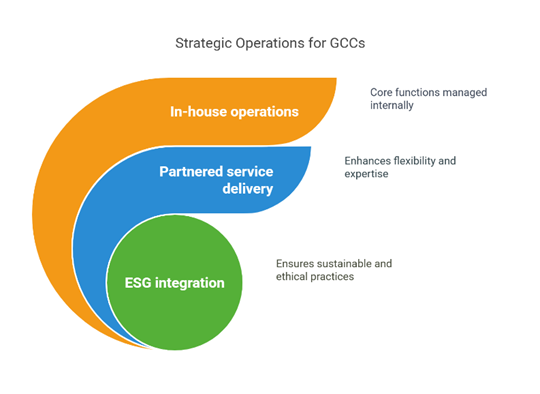
These strategies allow companies to balance cost, speed, and social impact in their transformation journeys.
Emerging Challenges: Talent, Compliance, and Equity
Despite advantages, challenges persist:
- Talent Saturation: Rising attrition and wage inflation in metros like Bangalore and Hyderabad
- Regulatory Complexity: Tougher privacy, IP, and compliance regulations necessitate investments in legal, cyber, and data governance
- Geographic Disparity: Over-reliance on metro locations limits diversity and resilience; Tier-II city expansion offers long-term benefits
Proactive recognition and mitigation of these risks is crucial to long-term GCC success.
GCC Maturity Framework: From Efficiency to Innovation
To assess a GCC's evolution, enterprises can adopt this four-stage maturity model:
| Maturity Stage | Core Focus | Capability Characteristics |
|---|---|---|
| Stage 1: Foundational | Cost arbitrage, support | Process standardization, basic shared services |
| Stage 2: Operational | Delivery excellence | Scalable operations, KPI ownership |
| Stage 3: Strategic | Value creation | Product ownership, CoEs, P&L contribution |
| Stage 4: Transformational | Enterprise innovation | AI/ML leadership, global mobility, ESG mandate integration |
This framework enables organizations to evaluate current positioning and prioritize initiatives for higher value realization.
Strategic Imperative for Global Enterprises
GCCs are now core enablers of enterprise transformation—from leading AI deployments to enabling ESG transparency. They form a foundation for building resilient, digitally-enabled, and future-proof organizations.
With its:
- Deep talent reservoir
- Infrastructure readiness
- Mature consulting and delivery ecosystem
India remains the destination of choice for launching and scaling next-generation GCCs.
Whether you're building a new GCC or expanding an existing one, choosing the right operational model and strategic partner is no longer optional—it’s a strategic imperative.
GCCs are no longer just delivery arms—they are innovation engines driving global competitiveness.