

In a post-efficiency era, GCC 2030 represents a fundamental shift in how global enterprises structure, scale, and secure long-term value. India, already home to 1,700+ Global Capability Centers (GCCs) and over 1.9 million professionals, is poised to drive the next frontier of global transformation, not just support it.
India is now poised to become the global hub for GCCs by 2030, driven by a skilled workforce, favorable policies, and strategic investments.
GCC 2030 is not a trend, it’s the operating model of the future, built on agility, innovation, and enterprise-wide alignment. This article explores how the next-generation GCC in India is evolving and why the time to act is now.
From Cost Arbitrage to Capability Creation
India’s early GCC models delivered back-office services and efficiency via labor arbitrage. But by 2025, this narrative has transformed. Cost efficiency is still important, but innovation, agility, and resilience are now essential for long-term relevance.
Global businesses now demand:

- Faster go-to-market
- AI-driven R&D acceleration
- Enterprise-grade governance
- Seamless cultural integration across geographies
GCC 2030: A Blueprint for Future-Ready Operations
According to SRKay’s GCC 2030 framework, tomorrow’s GCCs will be:
1. Virtual-First and Launch-Ready
- Operational in 90 days, with full remote enablement
- Seamless governance, compliance, and cost control from Day 1
2. Innovation-Centric
- Embedded AI, cloud, and analytics capabilities from setup
- Positioned to support HQ R&D agendas and global product teams
3. Co-Invested and Risk-Sharing
- Transition from vendor to strategic partner
- Shared investment models to align outcomes and reduce early-stage exposure
4. India Market Gateways
- Optional entry points into India’s USD 3.8 trillion nominal GDP economy
- High-growth potential in consumer, fintech, and healthcare sectors
Why India is Central to the GCC 2030 Strategy
1. Talent Depth & Innovation Maturity
- World’s largest pool of STEM and digital talent
- GCC workforce in India projected to reach 3 million by 2030
- 2.35 million AI professionals in GCCs today
- Women already account for 25%+ of the GCC workforce
- GCC’s R&D market projected to reach $49.38 billion by 2032
2. Policy-Led Acceleration
- Progressive GCC policies in Karnataka, Telangana, Maharashtra, and Uttar Pradesh
- Incentives on capex, recruitment, and fast-tracked clearances
- States like Maharashtra, MP & UP offering subsidies and skill development support
3. Sustainable Cost and Scale
- 45–55% cost savings on IT hiring vs. US benchmarks
- 37% faster time-to-market for innovation-led GCCs
- India's GCC market projected to grow from ~$64.6B (2024) to $110B by 2030
- GCCs to contribute up to 5% of India’s GDP by 2030 (up from 1.5–2% today)
Cultural Integration: The Competitive Advantage Most GCCs Miss
As GCCs evolve into innovation engines, cultural synergy is no longer optional — it’s foundational.

Key cultural challenges faced by GCCs:
- Hierarchy mismatches and ambiguous ownership
- Communication friction across regions
- Delayed approvals and compliance escalations
Top-performing GCCs invest in structured programs:
- Leadership Immersion: HQ–India rotations, shadow boards
- AI-powered cultural diagnostics: Sentiment analytics, feedback loops
- Localized onboarding and training based on real-world project contexts
Result: Up to 30% faster decision cycles, 20% higher retention, and greater innovation adoption
GCC Consulting: De-Risking the Journey to GCC 2030
To build a future-ready GCC in India, businesses must navigate legal, tax, talent, compliance, and infrastructure with precision. This makes GCC consulting critical.
Leading partners like SRKay offer:
- Virtual GCC launch within 90 days
- Full-service compliance: Transfer pricing, licenses, risk advisory
- Build-Operate-Transfer (BOT) and co-investment models
- India market feasibility and transition roadmaps
They don’t just set up offices — they build resilient, scalable, innovation-led centers.
Trends That Will Shape GCC 2030
AI-Native GCCs
- 30% of all GCCs estimated to be AI-powered by 2028
- Roles like AI ethics officers, quantum specialists, and data translators are scaling fast
Rise of Tier-II and Tier-III Cities
- 140+ greenfield GCCs launched in 30 months
- Indore, Bhubaneswar, Gandhinagar, Nagpur, Kochi, Ahmedabad, Vizag, and Coimbatore emerging as GCC hubs
- 20–30% lower OPEX in these locations enables decentralization
Integrated ESG & DEI
- Leadership scorecards now track cultural KPIs, DEI impact, and green ops
- ESG-linked performance becoming mandatory in BFSI and regulated industries
Infrastructure Transformation
- New GCCs opting for flexible workspaces, enabling scalability in dynamic business climates
Strategic Recommendations for Global Enterprises
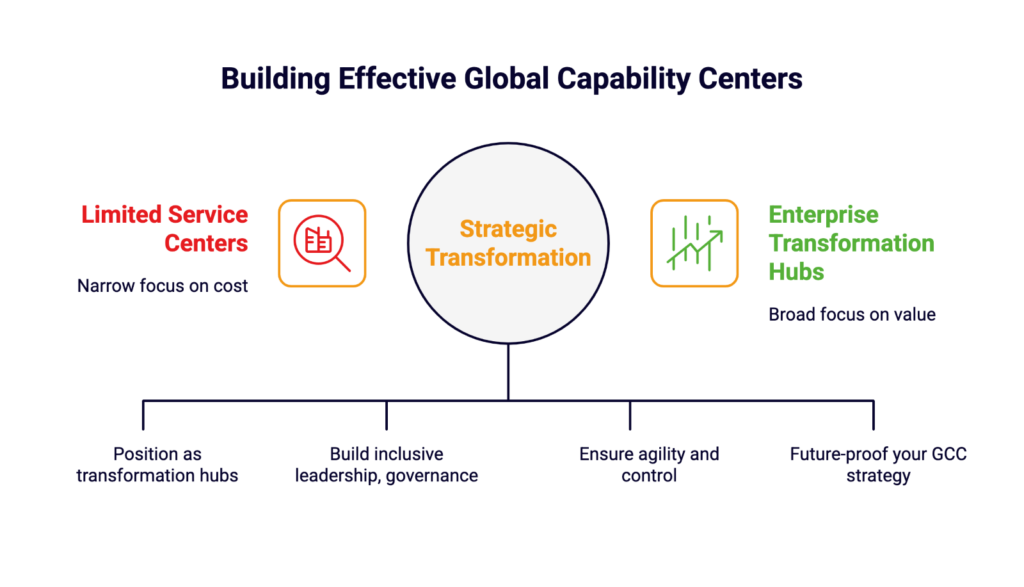
- Think beyond labor arbitrage: Position GCCs as enterprise transformation hubs
- Embed culture into the operating model: Inclusive governance, leadership alignment, and feedback systems from day one
- Adopt phased, de-risked growth models: Use virtual-first, BOT, and co-investment structures
- Partner with GCC consulting leaders: Future-proof strategy from concept to continuity
GCC 2030 is the Future — And India is Its Epicenter
The global capability center has evolved. GCC 2030 is not about where you operate — it’s about how you operate.
India offers everything need to build the next-generation GCC: talent, policy, innovation capacity, and a resilient delivery model.
Now is the time to lead the future.
Build your GCC 2030. In India. With confidence.